Skepticism. Ignorance. User-Understanding
The all knowing super-bot
If you haven’t heard of ChatGPT yet, you must have been living under a rock. It’s a groundbreaking development in generative AI that has already become a go-to tool for content generation, copy-editing, and search assistance. However, let me indulge in one of my pet peeves for a moment.
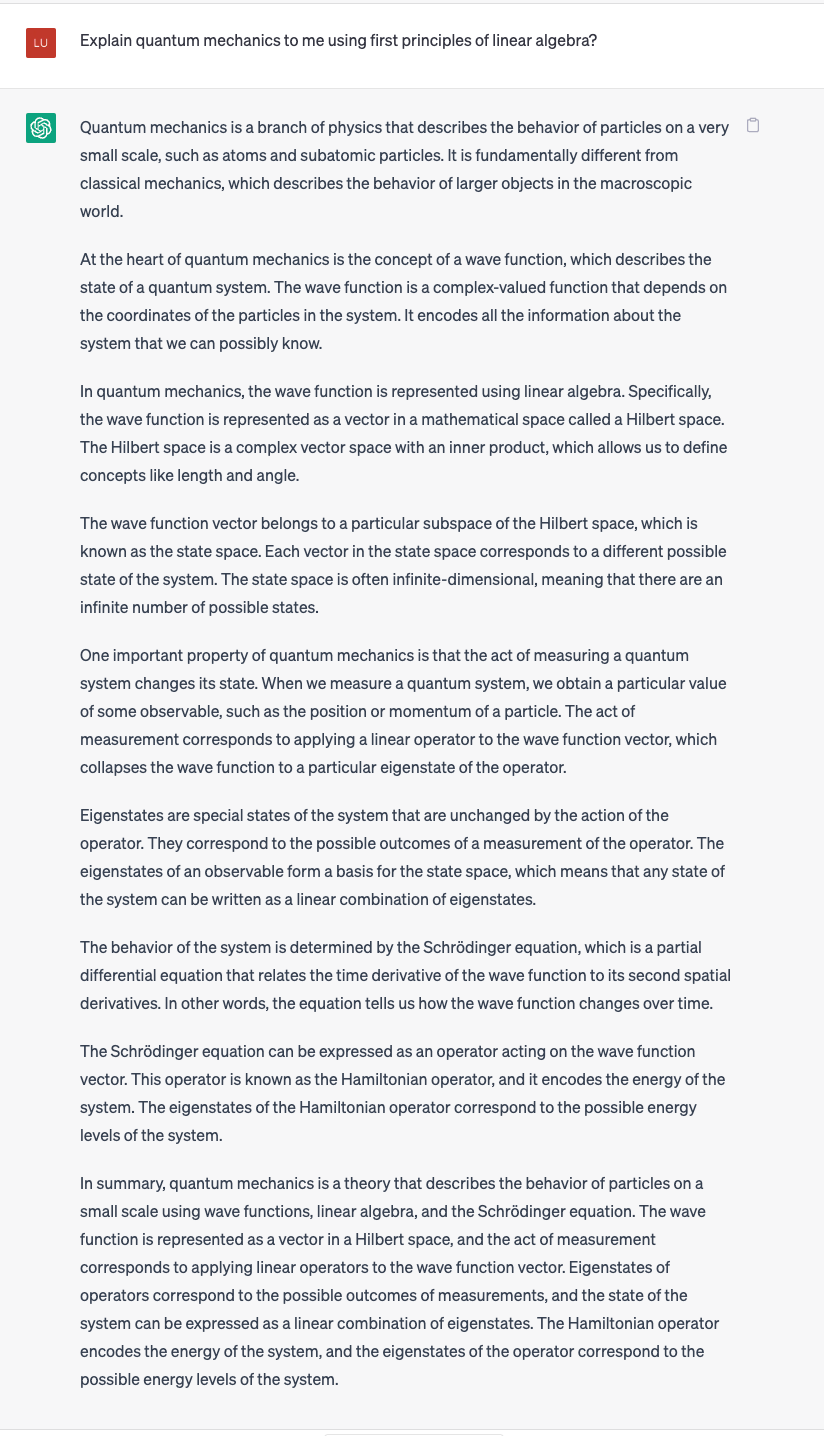
In the first scenario, I asked ChatGPT to explain quantum mechanics to me using the first principles of linear algebra, something well documented. It did a fair job without any instruction tuning.
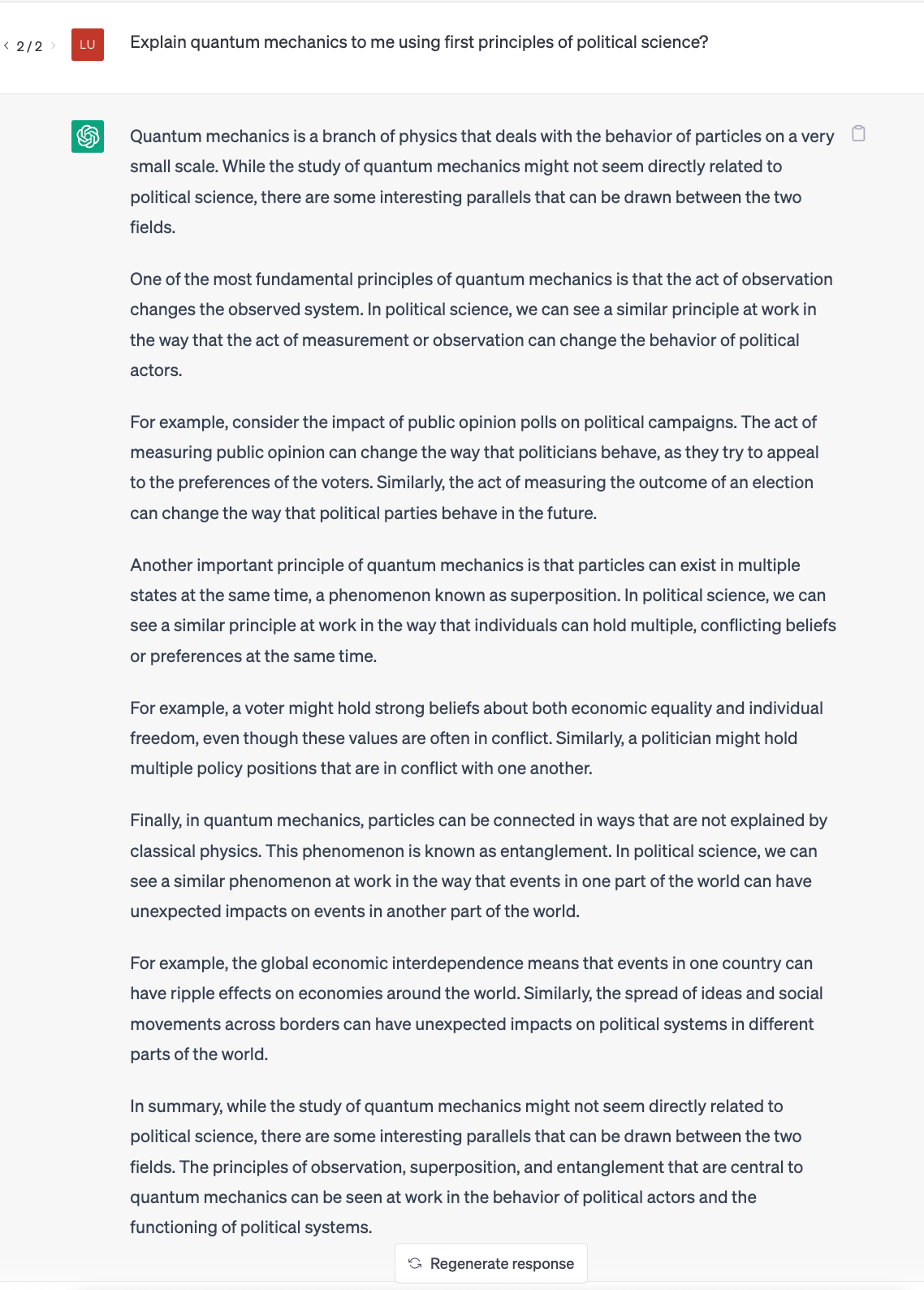
Now, let’s have some fun by asking something niche or absurd. In this case something absurd. “Explain quantum mechanics to me using first principles of political science?” The response is attached below for your examination and enjoyment.
I know it well, that I don’t know it yet
Renaissance. The Renaissance was a magical time in human history. It marked a fundamental shift in the method of accumulating knowledge, moving away from societal seniority-based opinions to testable hypothesis-based rigor, and from unquestioning faith to the best working hypothesis about the world.
One of the best aspects of this process of gaining knowledge is that it doesn’t have to be complete. It’s an ongoing process, with each new understanding being our “best working hypothesis” until it’s replaced by a new one with theoretical and experimental rigor. For example, Bohr’s model was once our best understanding of the atom, but our understanding has since evolved.
In each iteration of this process, the key to gaining more knowledge is acknowledging what we don’t know yet. “I don’t know” is a phrase used frequently by some of the smartest people I know, perhaps because they push themselves to the edge of their understanding, all that more often. By following it up with “I don’t know what/how/why yet, but these are the things we can look into…,” we lay the foundation for clear thinking and the pursuit of greater knowledge.
Expressing ignorance
The bayesian loop (Part 1 and 2) helps you express your ignorance just as well. In essence, the loop can be expressed as follows in the log space:
while (our knowledge has not converged):
    Knowledge (t) = Incoming evidence + Knowledge (t-1)
Now, let’s consider two scenarios. In the first scenario, we are extremely confident in our prior knowledge. In this case, we may want incoming evidence to change our prior knowledge at a slower pace and only accept it completely when we have seen overwhelming evidence over a long period of time. The above approach (and some popular ones based on the same idea) allow us to upweight our prior knowledge, slowing down our update speed. This approach allows us to be conservative with change.
In the second scenario, we are unsure about our knowledge of the world. In this case, we may want incoming evidence to change our prior knowledge at a very fast pace. We go where the data takes us until it settles down. This approach allows us to be more open to change and to adapt more quickly as new information becomes available.
A Simple User-Understanding Puzzle
In most mature user-facing systems, there are typically two types of users: power users and cold-start users.
- The power users: Those who enjoy using the system, know their way around it, and benefit from the system’s functionality.
- The cold-start users: Those who are still learning how to use the system, struggle to navigate it, and don’t yet receive the full benefits of the system’s features.
If we have a machine learning algorithm that outputs the topics and themes a user is interested in, should we weigh this knowledge differently based on our level of uncertainty about the user? Indeed.
For power users, a few random choices in a given day are unlikely to change our fundamental understanding of their preferences that we have accumulated over multiple days. Therefore, we should update our understanding of their preferences more slowly.
On the other hand, for cold-start users, we are less certain about their preferences and may need to take larger leaps of faith to converge towards a more accurate understanding.
 Amogh Mahapatra's Writings