Chaos. Einstein. Science-Fiction.

Imagine we have three celestial bodies, close enough and large enough to influence each other’s gravitational attraction. Unlike the scenario with two celestial bodies, their exact motion and trajectory cannot be precisely predicted. These celestial bodies will interact in complex, non-linear ways, resulting in a system highly susceptible to initial conditions, leading to unpredictable long-term outcomes. This is technically called chaos, and we’ve just discussed a fascinating unsolved problem in theoretical physics, the “Three-Body Problem.”
Now, what if a planet was under the influence of three suns? What would it be like to live on such a planet? For starters, the cycles of night and day and the seasons that we take for granted might not be so predictable. This system can occasionally find itself in stable configurations, leading to periods of predictable day-night cycles and seasons. However, these periods will be interspersed with chaos, during which the gravitational forces between the suns lead to unpredictable changes in the orbits, causing erratic changes in temperature, light, and gravitational forces on the planet’s surface. Imagine a thousand-year winter followed by twelve hours of spring!
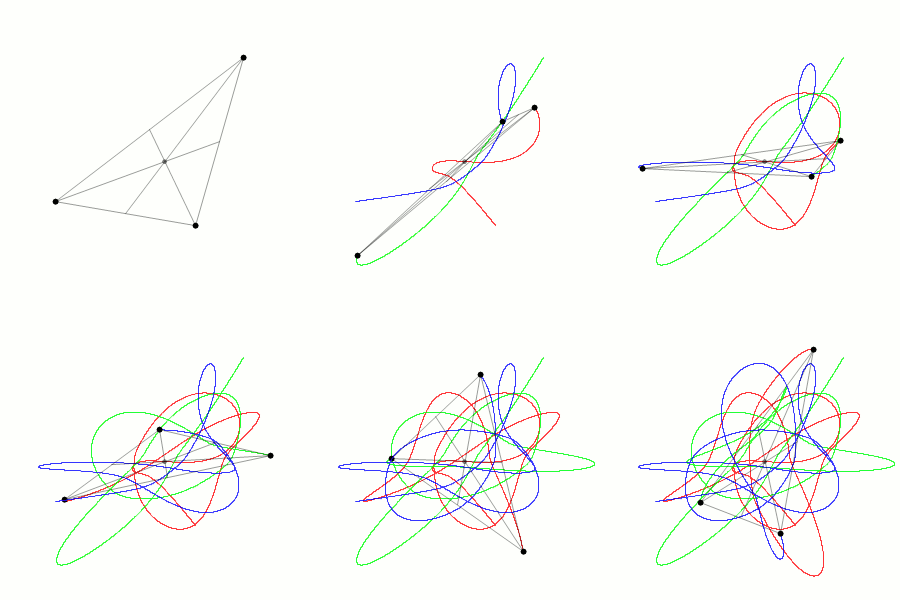
What would it be like to be a resident of this planet? The residents of Earth, spoiled by stability and predictability, complain about minor changes in weather and companionship. The residents of such a planet, where survival is insanely hard, might be ridiculously stoic and inventive, tough enough to live through eras of chaos, and inventive enough to deal with chaos’ aftermath. This is the premise of an amazing science fiction novel, also called, “The Three-Body Problem” (soon on streaming), which speculates the what-ifs at a grand interplanetary scale.
We imagine a world that differs from our own in one central aspect and then speculate on the “what-ifs” of this new world. This speculative thinking leads us to understand and isolate the effect of this central missing aspect. By asking “what if” questions about events that did not happen, we can infer the significance of events that did happen. This approach helps in isolating the effect of a particular factor by comparing what actually occurred with what could have occurred under different circumstances.
For example, what if we lived in a society where every single thing we did or said was recorded and monitored? What if some “big brother” was always watching over us? Would we feel safe or threatened? This is the central premise of the landmark science fiction novel “1984,” which helps us understand the trade-offs between control and privacy.
Books, and works of literature at least the best ones, make you think or feel by stirring something inside you. Good books and essays are dangerous; they contain conflicting ideas and viewpoints. Would their elimination lead to greater societal good and less chaos? “What if,” society decided to burn all the books, and the population was to be controlled and pacified by entertainment and propaganda? That is the premise of another classic, “Fahrenheit 451.”
In order to rigorously understand complex causal relationships in any given dynamical system with lots of interconnected components, we must break the existing paths and assumptions and engage in open “what-if” discussions and analysis. In the field of machine learning, the importance of counterfactual analysis is being felt more than ever. Most of the current success in applied fields like advertising and recommender systems has been on the back of collecting massive amounts of observational data. What if our fundamental assumptions about users and their interests were sub-optimal across various levels of abstraction? The only way to correct them is to indulge in this exercise, break down the existing assumptions, understand what the alternate reality looks like, and learn, rinse, adapt, and repeat.
Einstein was once traveling on a bus and happened to stare at a clock tower. He observed that when the bus is moving fast, he hardly sees the difference in the clock angles across two destinations. He then wondered, “what if,” the bus was moving as fast as it could (the speed of light), what would happen to the clocks? That led to the theory of relativity. This widely publicized anecdote from this great man’s life might not have actually happened, similar to Newton’s indulgence in the falling apple while sitting below a tree. Yet, it teaches us what the highest form of thinking is: indulging in thought experiments with well-defined counterfactuals.
It should now be clear why science fiction has always been a literature of choice for curious minds to entertain themselves and sharpen their thinking. All high-quality science fiction is based on a well-defined counterfactual, and then the resultant plot is simply a meditation of living in this new reality.
What if the Axis-Powers had won the Second World War? “Man in the High Castle.”
What if a ship could travel beneath the ocean for a very long time? “20,000 Leagues Under the Sea” (Led to many features in the modern submarines).
What if a planet had just one gender? “Left Hand of Darkness.”
What if we designed a world where we were happy all the time? “Brave New World.”
What if we could travel across eras? “The Time Machine.”
What if I could share my dreams with you? “Inception.”
“What-if” in essence is the most exhausting mental wrestling match you can play in your mind. But the good news is, this has been made fun and entertaining by the delightful genre of science fiction.
Post-Script:
Here is a link from a sitcom, explaining counterfactuals. link
 Amogh Mahapatra's Writings